How To Stop Wildlife From Putting Around
Golf is an extremely popular sport that is played both leisurely and professionally. However, golf is a profession where dealing with human-wildlife conflicts can be a daily occurrence. The golf industry is extremely large according to the Statistical Portal, from Spring 2016 to Spring 2017 25.95 million people played golf at least once. Maintaining a golf course means you constantly deal with all different kinds of wildlife conflicts.
Thomas Albert, whom works at a golf club in Virginia, gave us his insight into the issues they face. The interview is below:
Q: Where do you work?
A: Robert Trent Jones Golf Club in Gainesville, Virginia.
Q: What is your job title?
A: Golf Course Maintenance Intern
Q: Do you have to deal with human-wildlife conflicts daily with your job?
A: Yes. The majority of conflicts are with geese, but skunks, groundhogs, deer, and foxes cause issues as well.
Every course deals with a number of different species, largely depending on where they are located. Many golf courses have ponds, tall grass areas, and are surrounded by trees. According to Audubon International, these characteristics make courses extremely appealing to a multitude of species and wildlife conflicts.

Q: Are dealing with human-wildlife conflicts listed as part of your job responsibilities?
A: Indirectly yes. Wildlife can cause damage to our playing surfaces and it is my responsibility to fix damage and do what I can to prevent damage.
Q: What human-wildlife conflicts do you encounter and with what animals?
A: The majority of the human-wildlife conflicts I encounter are with geese causing damage on our playing surfaces by digging for food, as well as leaving a multitude of feces. With deer, the major issue is their hoof prints cause damage on our putting greens and bunkers. Skunks, foxes, and groundhogs only cause us issues if they dig on our greens or search for grubs in newly laid sod.
 According to Goose Busters, in 2007 golf courses were spending on average over a thousand dollars a year dealing solely with geese feces removal. Geese feces is just one conflict dealt with by golf courses, the addition of dealing with all other conflicts must add up to be a hefty cost.
Q: What are some ways you prevent these conflicts?
A: Our main source of prevention is our presence on the course. Unfortunately, we are not present 24/7 so for geese, which are our main conflict, we use coyote decoys to scare off the geese. Other methods include lights to disrupt their sleeping schedule or dogs trained to chase geese away.
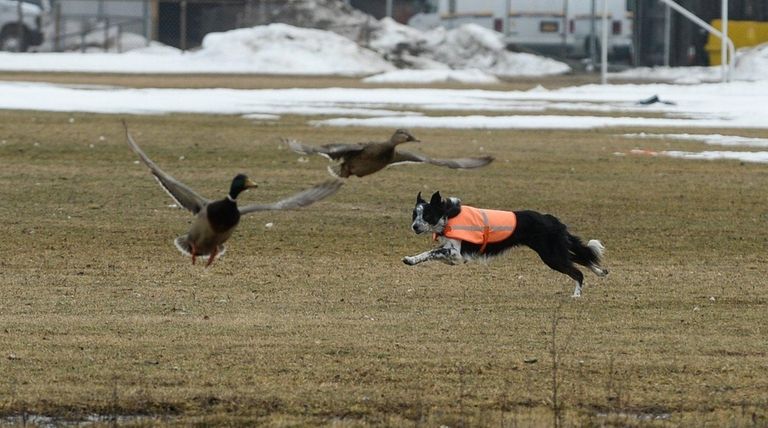
The use of dogs has proven to be a very popular and effective technique. The superintendent of the Fairview Country Club stated they “had over 600 geese in 1992” and just two short years later after the implementation of geese dogs “were down to just 10 geese.”
The golfing industry has had many years to determine effective ways to deal with wildlife. They have found some techniques that have proven to be transferable to other human-wildlife conflicts around the world. Some of these techniques include, lights to scare away elephants and dogs to intimidate and scare cheetahs.
So next time you step up to the tee, take a look around and see if you notice any wildlife deterrent practices!
A special thanks to Thomas Albert for talking with us!
The golfing industry has had many years to determine effective ways to deal with wildlife. They have found some techniques that have proven to be transferable to other human-wildlife conflicts around the world. Some of these techniques include, lights to scare away elephants and dogs to intimidate and scare cheetahs.
So next time you step up to the tee, take a look around and see if you notice any wildlife deterrent practices!
A special thanks to Thomas Albert for talking with us!


Thomas Albert seems like an interesting guy.
ReplyDelete